A group of organic molecules were having a party, when a group of robbers broke into the room and stole all of the guest's joules. A tall, strong man, armed with a machine gun came into the room and killed the robbers one by one. The guests were very grateful to this man, and they wanted to know who he was. He replied: My name is BOND, Covalent Bond.
Wednesday, December 15, 2010

Sunday, December 12, 2010
Lab 4C
We did a lab on Thursday and it was about the composition of the hydrate.
The purpose of the lab was to determine the percentage of water in an unknown hydrate, to determine the moles of water present in each mole of this unknown hydrate, when given the molar mass of the anhydrous salt and to find out the empirical formula of the hydrate.
So the procedure of this lab was:
- put on safety equipment (always the most important)
- set up the equipment (ring stand, ring, bunsen burner, pipestem triangle, crucible, and crucible tongs)
- turn on the bunsen burner to dry the crucible
- remove the burner and allow the crucible to cool for about 3 minutes
- determine the mass of the empty crucible
- place 1/3 full of hudrate and determine the mass (record it down)
- place the crucible and contents on the pipestem triangle and heat until the crucible is a dull red (maintain the temperature for 5 minutes)
- turn off and allow the crucible to cool for 5 minutes
- record the mass
- reheat the crucible for another 5 minutes, cool as before, and determine the mass (the mass should be the same as the first one)
- add water to the content of the crucible and note any changes that occur

Analysis of Results
1) The percentage of water in the hydrate is calculated by :
mass of water divided by mass of hydrate x 100%
2) The number of moles the anhydrous salt left behind is calculated by :
Mass after heating – mass of crucible = mass of anhydrous salt
Moles of anhydrous salt = mass of anhydrous salt x 1 mole = moles of anhydrous salt 120.4g
3) The number of moles of water removed by the heat is calculated by :
Mass of hydrate = mass of crucible & hydrate – mass of crucible
1) The percentage of water in the hydrate is calculated by :
mass of water divided by mass of hydrate x 100%
2) The number of moles the anhydrous salt left behind is calculated by :
Mass after heating – mass of crucible = mass of anhydrous salt
Moles of anhydrous salt = mass of anhydrous salt x 1 mole = moles of anhydrous salt 120.4g
3) The number of moles of water removed by the heat is calculated by :
Mass of hydrate = mass of crucible & hydrate – mass of crucible
mass of water = mass of hydrate – mass of salt
Moles of water = mass of water x 1 mole = moles of water
18g
4) The moles of water per mole of anhydrous salt is calculated by :
Moles of water divided by moles of salt is the ratio of water to anhydrous salt
5) The empirical formula of the hydrate is MgSO4 · 7H2O Magnesium Sulphate Heptahydrate.
Follow-Up Questions
1) SOURCES OF ERROR
- NOT HEATING IT TO BLUE FLAME
- HEATING IT WAY TOO LONG
- WRONG MEASUREMENT
- USING THE WRONG EQUIPMENT
2) Solution :
Na => 16.1g x 1 mole = 0.7 moles of Na x3 2 23g
C => 0.35 moles of C x3 1
O => 1.05 moles of O x3 3
O => 1.05 moles of O x3 3
Water => 3.5 moles of water x3 10
The empirical formula is Na2Co3 · 10H2O
3) Solution:
Molar Mass of Na2CO3 x 5.82g = 106g/mol x 5.82 = 2.16g
Molar Mass of Na2CO3 · 10H2O 286g/mol
Molar Mass of Na2CO3 · 10H2O 286g/mol
4) Solution:
Moles of Na 18.53g x 1 mole = 0.806 moles of Na 1 x 2 2 23g
S = 0.806 moles of S 1 x 2 2
O = 1.21 moles of O 1.5 x 2 3
O = 1.21 moles of O 1.5 x 2 3
H2O = 2 2.5 x 2 5
The empirical formula is Na2S2O3 · 5H2O.
VIDEOS!
Empirical Formula : Hydrate
Wednesday, December 8, 2010
The Empirical Formula of Organic Compounds
Finding the empirical formula of an organic compound (any substance with carbon in it) is pretty similar to calculating the empirical formula to other substance. Except it has one additional step at the end.
It can be found by:
- Burning the compound (reacting it with O2)
- Collecting and weighing the products
- The mass of the products, the moles of each element in the original organic compound can be calculated
There are 4 steps you need to follow if you want to find the empirical formula correctly.
Here is an example question and the steps that follow.
What is the empirical formula of a compound that when a 5g sample is burned produces 15g of CO2 and 8.18g of H2O?
Step 1
Calculate the moles of CO2 + H2O produced.
mol CO2 = 15g CO2 x (1 mol CO2/44.0g CO2) = 0.341 mol
mol H2O = 8.18g H2O x (1 mol H2O/18.0g H2O) = 0.454 mol
Step 2
Find the moles of C + H in CO2 and in H2O.
mol C = 0.341 mol CO2 x (1 mol C/1 mol CO2) = 0.341 mol C
mol H = 0.454 mol H2O x (2 mol H/ 1 mol H2O) = 0.908 mol H
Step 3
The ratio of moles of C to moles of H in the organic compound is 0.341: 0.908.
Therefore the formula could be: C0.4341H0.908 BUT the ratio must be whole numbers.
Step 4
Change the ratio to a whole number ration by multiplying in turn by 2/2, 3/3, 4/4 until you get a whole number ratio.
Ratio of moles = 0.908 mol H/ 0.341 mol C = (2.66/1) x 3/3 = 8/3
The empirical formula = C3H8
It can be found by:
- Burning the compound (reacting it with O2)
- Collecting and weighing the products
- The mass of the products, the moles of each element in the original organic compound can be calculated
There are 4 steps you need to follow if you want to find the empirical formula correctly.
Here is an example question and the steps that follow.
What is the empirical formula of a compound that when a 5g sample is burned produces 15g of CO2 and 8.18g of H2O?
Step 1
Calculate the moles of CO2 + H2O produced.
mol CO2 = 15g CO2 x (1 mol CO2/44.0g CO2) = 0.341 mol
mol H2O = 8.18g H2O x (1 mol H2O/18.0g H2O) = 0.454 mol
Step 2
Find the moles of C + H in CO2 and in H2O.
mol C = 0.341 mol CO2 x (1 mol C/1 mol CO2) = 0.341 mol C
mol H = 0.454 mol H2O x (2 mol H/ 1 mol H2O) = 0.908 mol H
Step 3
The ratio of moles of C to moles of H in the organic compound is 0.341: 0.908.
Therefore the formula could be: C0.4341H0.908 BUT the ratio must be whole numbers.
Step 4
Change the ratio to a whole number ration by multiplying in turn by 2/2, 3/3, 4/4 until you get a whole number ratio.
Ratio of moles = 0.908 mol H/ 0.341 mol C = (2.66/1) x 3/3 = 8/3
The empirical formula = C3H8
Sunday, December 5, 2010
JOKE OF THE DAY
> >A psychotic chemist came home from work and had a big
> >fight with his wife. In the heat of the moment, he
> >grabbed a bottle of some lethal chemical substance and
> >forced her to drink it while he screamed: " Die Ethyl,
> >die". The wife dropped dead on the floor and the
> >neighbors who were watching the scene, decided to call
> >the police. The policemen arrived and arrested the
> >chemist. One of them asked: Was there any reason for
> >you to kill your wife? The chemist replied: " There
> >was no chemistry between us. We never bonded well
> >although we tried.In the compound where we lived, our
> >temperaments collided. She always responded negatively
> >to my comments. Our relationship was unstable. There
> >was no possible solution. She had an attitude and I
> >was explosive. Finally, I overreacted. But now I'm
> >glad it's over. I'm in equilibrium again.I will feel
> >free even behind the irons."
> >fight with his wife. In the heat of the moment, he
> >grabbed a bottle of some lethal chemical substance and
> >forced her to drink it while he screamed: " Die Ethyl,
> >die". The wife dropped dead on the floor and the
> >neighbors who were watching the scene, decided to call
> >the police. The policemen arrived and arrested the
> >chemist. One of them asked: Was there any reason for
> >you to kill your wife? The chemist replied: " There
> >was no chemistry between us. We never bonded well
> >although we tried.In the compound where we lived, our
> >temperaments collided. She always responded negatively
> >to my comments. Our relationship was unstable. There
> >was no possible solution. She had an attitude and I
> >was explosive. Finally, I overreacted. But now I'm
> >glad it's over. I'm in equilibrium again.I will feel
> >free even behind the irons."
Empirical and Molecular Formula

Empirical Formula gives the lowest term ratio of atom in the formula
Finding the empirical formula is somewhat the reverse of finding percentage composition. ( see below)
First you will be given the percentages of each element in a particular compound.
Assuming that you will always be given a 100 gram sample we will convert these percentages to grams. The next step is to find the ratio of moles of each element and then calculate the simplest ratio of subscripts that maintain that ratio.
It is much easier done than said!
Lets start with this data: 36.5% Na, 25.4% S, and 38.1% O
First, convert each percentage to grams : 36.5 g Na, 25.4 g S, 38.1 g O.
Next, divide each by the grams/mole of that element:
Na: 36.5 g / 23.0 g/mol = 1.58 mol Na
S: 25.4 g / 32.1 g/mol = 0.791 mol S
O: 38.1 g / 16.0 g/mol = 2.38 mol O
Now we can set up the ration of moles of each element:
Na S O
1.58 0.791 2.38
To convert these decimal numbers into whole numbers and maintain the same ration between them, just divide each by the smallest of the subscripts.
1.58/0.791
0.791/0.791
2.38/0.791
Our final formula would look like: Na2SO3 ( sodium sulfite)
MORE EXERCISES!!! :)

Molecular Formula is a multiple of the empirical formula
Molecular Formula = Molar Mass / Molar Mass of empirical formula
To find the molecular formula, first find the empirical formula for the data you have been given. Then compare the formula mass for your empirical formula with the formula mass for the molecular formula. You may have to multiply the subscripts in your empirical formula by some factor.
Sample Problem.
Given: 38.7% C, 9.70% H, 51,6% O and a molecular formula mass of 62.0 find the molecular formula:
First, find the empirical formula ===> CH3O
Next find the formula mass: C 1 x 12.0 = 12. 0
H 3 x 1.01 = 3.03
O 1 x 16.0 = 16.0
Formula mass = 31.0
Now divide the molecular mass by this formula mass : 62.0 / 31.0 = 2
Multiply each subscript in your formula by this factor ( 2 here)
Your final molecular formula: C2H6O2
To check your answer find the formula mass of your final formula. It should be the same as the molecular formula mass.
Practice:
Given the following data, find the correct molecular formula:
34.6% C , 9.00% H, 36.4% O and a molecular mass of 176
The correct answer would be: C8H16O4
The empirical formula would be: C2H4O with a formula mass of 44
The multiplication factor would be 4 ( 176/44.0)
ONE MORE TIME!

VIDEO!!!!!!!!!!!!!! (:

Thursday, December 2, 2010
Percentage Composition
The percent composition (percentage composition) of a compound is a relative measure of the mass of each different element present in the compound.
To calculate the percent composition (percentage composition) of a compound
Example:
NaCl
The answers above are probably correct if %Na + %Cl = 100, that is,
39.34 + 60.66 = 100.
28.19 + 8.11 + 20.77 + 42.93 = 100
How to calculate percent composition?
Hmm...
(:
To calculate the percent composition (percentage composition) of a compound
- Calculate the molecular mass MM, of the compound
- Calculate the total molar mass of each element present in the formula of the compound
- Calculate the percent composition (percentage composition)
Example:
NaCl
- Calculate the molecular mass (MM):
MM = 22.99(Na) + 35.45(Cl) = 58.44g/mol - Calculate the total molar mass of Na present:
1 Na is present in the formula, molar mass = 22.99g/mol - Calculate the percent by weight of Na in NaCl:
%Na = (molar mass Na ÷ MM) x 100 = (22.99 ÷ 58.44) x 100 = 39.34% - Calculate the total mass of Cl present:
1 Cl is present in the formula, molar mass = 35.45g/mol - Calculate the percent by weight of Cl in NaCl:
%Cl = (molar mass Cl ÷ MM) x 100 = (35.45 ÷ 58.44) x 100 = 60.66%
39.34 + 60.66 = 100.
Calculate the percent by weight of each element present in ammonium phosphate [(NH4)3PO4]
- Calculate the molecular mass (MM) of (NH4)3PO4:
MM = 3x[14.01 + (4 x 1.008)] + 30.97 + (4 x 16.00) = 3 x [14.01 + 4.032] + 30.97 + 64.00 = (3 x 18.042) + 30.97 + 64.00 = 54.126 + 30.97 + 64.00 = 149.096 - Calculate the total mass of N present:
3 N are present, mass = 3 x 14.01 = 42.03 - Calculate the percent by mass of N present in (NH4)3PO4:
%N = (mass N ÷ MM) x 100 = (42.03 ÷ 149.096) x 100 = 28.19% - Calculate the total mass of H present:
12 H are present in the formula, mass = 12 x 1.008 = 12.096 - Calculate the percent by mass of H present in (NH4)3PO4:
%H = (mass H ÷ MM) x 100 = (12.096 ÷ 149.096) x 100 = 8.11% - Calculate the total mass of P present:
1 P is present in the formula, mass = 30.97 - Calculate the percent by mass P in (NH4)3PO4:
%P = (mass P ÷ MM) x 100 = (30.97 ÷ 149.096) x 100 = 20.77% - Calculate the total mass of O present:
4 O are present in the formula, mass = 4 x 16.00 = 64.00 - Calculate the percent by mass of O in (NH4)3PO4:
%O = (mass O ÷ MM) x 100 = (64.00 ÷ 149.096) x 100 = 42.93%
28.19 + 8.11 + 20.77 + 42.93 = 100
How to calculate percent composition?
Hmm...
(:
Tuesday, November 23, 2010
Mole Conversion
Recall: 1 mol = 6.022 E 23 units of substance
Conversion between particles and mole
To do this type of questions, you have to know the molar mass of the substance. Using the periodic table we can find the molar mass, or the mass of a mole of a substance. The unit of the molar mass is grams/ mol
the following question is more difficult and a mole map can help you understand it.

Conversion between particles and mole
- Particles to mole
- multiplied particle/ formula units/ molecules by 1 mol/6.022 x 10^23
- Example: How many moles of barium nitrate (BaNO3) contain 6.80 x 10^24 formula units?
- Well, to do this, divide 6.80 x 10^24 by Avagadro's number, 6.022 x 10^23, to get 11.29 moles.
- multiplied mole by 6.022 x 10^23/ 1 mol
- Example: Determine the number of atoms that are in 0.58 mol of Se
- If you're thinking you multiply .58 moles by 6.022 x 10^23 atoms/mol, you're absolutely right. This yields the answer of 3.49 x 10^23 atoms of Se.
To do this type of questions, you have to know the molar mass of the substance. Using the periodic table we can find the molar mass, or the mass of a mole of a substance. The unit of the molar mass is grams/ mol
- Moles to grams
- multiply moles by _grams / 1mol
- Example: how many grams are there in 2.04 moles of Carbon?
- To do this question, first you have to find the molar mass of C and it is 12.0g/ mol. Then, you multiply 2.04 mole by 12.0g/ 1 mol and get the answer of 24.5g of C
- multiply grams by 1 mol/ _grams
- Example: how many moles are in 3.45 g of Carbon?
- Well, the molar mass of Carbon is 12.0 g/ mol so you multiply 3.45 g by 12.0g/ mole and get the answer of 0.288 mol.
the following question is more difficult and a mole map can help you understand it.

- Particles to mass
- To do this type of question:
- Find the moles of the item you wish to convert
- Determine the molar mass of the item you wish to convert. (set up the conversion factor - this time moles are on the bottom)
- Set up the equation and solve
- Example: what is the mass of 2.78 x 10^ 22 Fe atoms?
- To do this, we multiply 2.78 x 10^ 22 by 1 mol/6.022 x 10^23 and times the molar mass: 55.8 g/ 1 mole to the answer and get 2.58 g Fe
- The rules for this type of questions are
- Find the mass of the item you wish to convert
- Determine the molar mass of the item you wish to convert.
- Set up the equation and solve.
- Example: how manu atoms of Iron in 20.0 g of Iron?
- For this question, we time 20.0 g by the molar mass of the Iron : 1 mol/ 55.8 g, then we multiply the result 6.022 x 10^23/ 1 mol and get the result of the number of atoms, which is 2.16 x 10^ 23 atoms of Fe
Saturday, November 20, 2010
Atomic Mass, Formula Mass, and Molar Mass
Yay it was snowing last night :). Who doesnt love snow??? (besides people who drive.) Anyways, this blog is for science... So, the last 2 classes we learnt about different masses and how to find them. Here are the notes to remind you of what we know so far.
Avogadro's Hypothesis
- The volumes of different gases at the same temperature and pressure have the same amount of particles.
- If they have the same number of particles, mass ratio is caused by the mass of the particles
- This principle is used for the relative mass of all the atoms on the periodic table
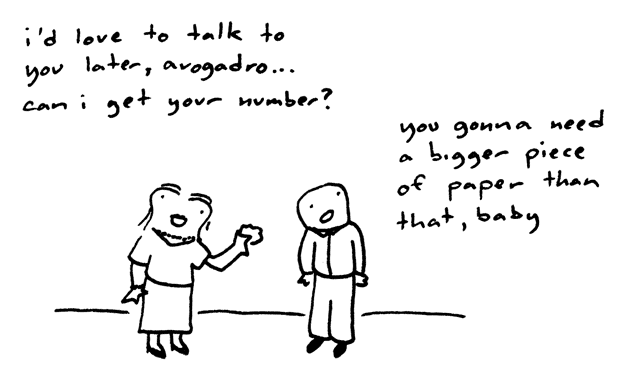
Avogadro's Number (not phone number :p)
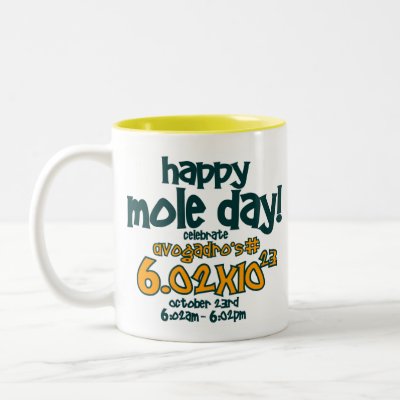
-The number of particles in 1 mole of any amount of substance is 6.022x10²³ particles/mole
- The mole allows chemists to count atoms and molecules a lot easier.
-Atoms can also be counted by weighing
Relative Mass
-It is the mass of the different elements that make up a particular formula.
Atomic Mass
- The mass of an atom of a chemical element expressed in atomic mass units. (Its found on the periodic table to make it easier.)

* amu stands for atomic mass units
Formula Mass
- All atoms of a formula of an ionic compound (in amu)
ex: Potassium has 39.1 atomic mass and Fluorine has 19.0. That would mean KF (potassium fluoride) would equal to 58.1 amu. Just need to add the atomic mass.
Molecular Mass
- All atoms of a formular in a covalent compound. (in amu)
ex: O2 would be 16.0u + 16.0u = 32.0u
Molar Mass
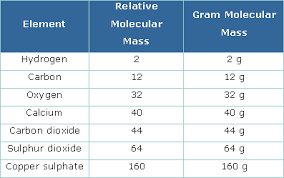
- The mass of 1 mole (6.022x10²³ particles) in a substance and is the same numerical value of atomic mass, formula mass, or molecular mass but expressed in GRAMS PER MOLE.
ex: The molecular mass of oxygen is 16.0u and the molar mass of oxygen is 16.0g/mole.
That's all for today :)
HAVE FUN IN THE SNOW!!

Avogadro's Hypothesis
- The volumes of different gases at the same temperature and pressure have the same amount of particles.
- If they have the same number of particles, mass ratio is caused by the mass of the particles
- This principle is used for the relative mass of all the atoms on the periodic table
Avogadro's Number (not phone number :p)
-The number of particles in 1 mole of any amount of substance is 6.022x10²³ particles/mole
- The mole allows chemists to count atoms and molecules a lot easier.
-Atoms can also be counted by weighing
Relative Mass
-It is the mass of the different elements that make up a particular formula.
Atomic Mass
- The mass of an atom of a chemical element expressed in atomic mass units. (Its found on the periodic table to make it easier.)
* amu stands for atomic mass units
Formula Mass
- All atoms of a formula of an ionic compound (in amu)
ex: Potassium has 39.1 atomic mass and Fluorine has 19.0. That would mean KF (potassium fluoride) would equal to 58.1 amu. Just need to add the atomic mass.
Molecular Mass
- All atoms of a formular in a covalent compound. (in amu)
ex: O2 would be 16.0u + 16.0u = 32.0u
Molar Mass
- The mass of 1 mole (6.022x10²³ particles) in a substance and is the same numerical value of atomic mass, formula mass, or molecular mass but expressed in GRAMS PER MOLE.
ex: The molecular mass of oxygen is 16.0u and the molar mass of oxygen is 16.0g/mole.
That's all for today :)
HAVE FUN IN THE SNOW!!
Wednesday, November 10, 2010
Joke of the day!
A small piece of sodium that lived in a test tube fell in love with a Bunsen burner. "Oh Bunsen, my flame," the sodium pined. "I melt whenever I see you," The Bunsen burner replied, "It's just a phase you're going through."
GRAPHING!! (:
So.... for 2 classes we did graphs by using the microsoft excel.
Graphs that were taken includes: Density of Water, Density of Hot water, Temperature Vs volume of gas and lastly Mass Vs Volume.
How to graph?
As an example, here's how to graph the Density of Water.
STEPS:
- open excel
- plug in all the numbers for volume(mL) and mass (g) { make sure its separated into 2 columns}
- highlight both column then click "chart"
- choose "scatter"
- lable: title, subtitle, trend line type ( highlight + click "show formula" to get the formula) , x and y value

- click "add decimal place ( or something)" if the # keeps rounding itself to 1 ( this refer to the last 2 graph that we did)
- NOW, you get to design your graph. BE creative. Do ANYTHING you want. Lol
Question: Which one has a higher density? Cold water or Hot water?
Answer: Cold water, because as you heat water its molecules gain kinetic energy and the water becomes much less denseVIDEO!
.. on Water Density.
Subscribe to:
Posts (Atom)